


Why Thai Spirits Look the Same on the Shelf: And What They Actually Are
Updated: Jul 6
Pick up a bottle of Choeng Doi Blanc and a bottle of Ruang Khao. Both are clear. Both are Thai. Both carry some version of the same regulatory classification. Put them next to each other on a shelf and, without any prior knowledge, a consumer has very little to go on.
That is the central problem facing Thai craft spirits right now. Not the quality of what is being made, which has genuinely improved, but the near-total absence of a shared language to describe it.
Thailand is producing an increasingly diverse range of spirits: rice distillates rooted in traditional fermentation culture, contemporary rice spirits made from named varieties with real agricultural identity, sugarcane spirits that sit comfortably alongside the world's best cane juice distillates, and botanical spirits built on ingredients with no equivalent in any European recipe. The category, in other words, is not one thing. It just looks that way at the point of sale.

The Regulation Behind the Confusion
To understand why the shelf looks the way it does, it helps to understand the classification system that governs it.
Lao Khao (เหล้าขาว) translates as "white spirit" and has historically referred to Thailand's traditional rice-based distillate. The term is culturally specific: it describes a practice embedded in rural and agricultural life, varied by region, shaped by local fermentation traditions and rice varieties. It is not a single product. It never was.
In contemporary regulation, however, Lao Khao functions as a broad administrative category. Thai excise law defines distilled spirit classifications primarily by alcohol content and production method, not by raw material or flavour profile. The result is that craft producers seeking to operate legally often have little choice but to register their products within existing categories, regardless of whether those categories describe what they are actually making.
This means a single-estate sugarcane spirit fermented with wild yeast and distilled in copper can end up carrying the same label as a mass-produced neutral grain spirit. A botanical spirit redistilled over kaffir lime and galangal sits in the same category as a traditional village rice distillate. The regulation reflects what Lao Khao once was. It has not kept pace with what Thai spirits have become.

The Shelf in Practice
The effects of this become most visible when you look at what actually occupies a Thai spirits shelf from one end to the other.
At the volume end, Ruang Khao and Red Cock (Kai Daeng) are ubiquitous: column-distilled rice spirits, consistent, affordable, and present in virtually every convenience store, wet market, and roadside restaurant in the country. Hong Thong white, produced by ThaiBev, occupies similar territory with the distribution reach of one of Southeast Asia's largest drinks conglomerates behind it.
These are not spirits produced with terroir or fermentation character in mind. They are produced for scale, and they do that job well. The problem is not that they exist. The problem is that nothing on the shelf reliably distinguishes them from what sits beside them.
Because beside them, in many environments with minimal visual differentiation, are products of an entirely different order.
A bottle of Choeng Doi Blanc, made from fresh-pressed sugarcane juice on a small agricultural estate in Northern Thailand, shares a classification with Ruang Khao despite having more in common with a well-made rhum agricole from Martinique. SONKLIN, produced from Sanpatong sticky rice grown in the mountain valleys around Chiang Dao, carries the same category label as the industrial column distillate next to it on the shelf.
This is not a marginal or theoretical issue. It is the central structural problem facing Thai craft spirits at the retail level.
What Category Compression Actually Costs
When genuinely distinct products are presented as if they belong to the same category, there are consequences for everyone involved.
The most immediate is price anchoring. A consumer encountering a bottle of LILIT, a traditionally produced Lao Khao made with genuine fermentation integrity, next to a litre of Ruang Khao has no visible reason to understand why the price differs. The craft producer is not being penalised for quality. They are being penalised for the absence of a shared language through which quality can be communicated. Without that language, the consumer defaults to the familiar.
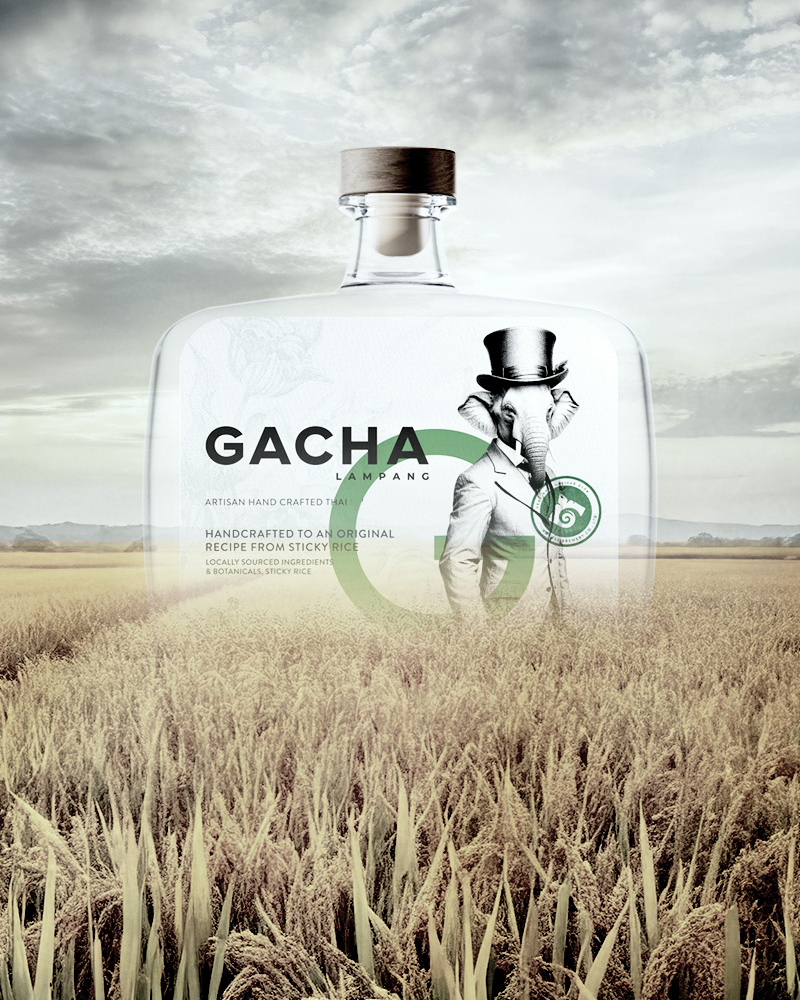
Discoverability suffers just as much. Inchon (Chonburi), Nakin, Anong (Songkhla), and Gacha (Lampang) are all making botanical spirits with a distinct regional identity, built on ingredients that have no equivalent in any European gin recipe. But in a retail environment where the only visible differentiators are bottle design and price point, that identity requires explanation that a shelf label cannot provide. These brands find their audience through hospitality and recommendation. The casual browser, without a knowledgeable guide, rarely finds them at all.
The broader cost is to category credibility. When the same classification applies to both the mass-market volume tier and a single-estate agricultural distillate, neither end benefits. The craft producers cannot claim the differentiation their production warrants. The category as a whole is difficult to position as a premium proposition, because nothing in the retail environment supports that positioning.
What the Shelf Is Actually Hiding
Set aside the labels and look at what is genuinely being produced. The diversity is real, and it matters.
Industrial Lao Khao
Ruang Khao, Red Cock, and Hong Thong white form the volume foundation of the Thai spirits market. These are high-output, column-distilled rice spirits built for consistency and accessibility. They are not without a role: they have built the consumer base that craft producers are beginning to draw from, and they are the reference point against which everything else in the category is implicitly measured. Understanding them as the baseline is essential to understanding why everything above that baseline requires active explanation.
Traditional Lao Khao
The traditional rice distillate is more varied and more interesting than its commercial reputation suggests. Production involves the fermentation of cooked glutinous rice using luk paeng, traditional starter cultures that vary by region and carry real microbial character. Different areas of Thailand maintain distinct fermentation traditions, and the resulting spirits reflect those differences in ways that are legible to an attentive palate.
LILIT works within this tradition deliberately. Rather than reframing Lao Khao as something other than what it is, LILIT makes the case, through production, that what it is has been systematically undervalued. The fermentation character that industrial production removes is precisely what LILIT preserves. These are spirits that belong in a cultural and culinary context, and they reward engagement with that context.

Contemporary Rice Spirits
A distinct contemporary approach to rice distillation is developing alongside the traditional one. It draws on the same raw material traditions but pursues a different sensory outcome.
SONKLIN, made by Choeng Doi Distillery from Sanpatong sticky rice grown in the Chiang Dao valleys, is the clearest example. Sanpatong is a named variety with specific starch characteristics and fermentation behaviour. It is not a generic raw material. The production approach is built around that specificity: fermentation managed to develop character without sacrificing clarity; distillation used to refine rather than to erase.
The result is a rice spirit with enough precision to function well in cocktails and enough identity to hold its own neat. The closest comparison points are not other Thai rice spirits but the better precision rice shochu from Japan, or the named-variety grain spirits beginning to emerge from other Asian producing countries. On the shelf, there is nothing to communicate any of this.

Sugarcane Spirits
Sugarcane spirits represent perhaps the clearest example of how badly category compression serves the Thai market.
The useful international reference is rhum agricole: spirits made from fresh-pressed cane juice, fermented and distilled to reflect the agricultural character of the raw material rather than to produce a neutral or standardised spirit. Thai cane juice producers are working within this broad tradition, whilst developing approaches shaped by their own varieties, soils, and climates.
Choeng Doi Distillery runs two distinct programmes. Choeng Doi Blanc is a perpetual reserve, integrating successive harvests and multiple estate sources into a profile that remains consistent whilst evolving over time. The Single Estate Sugarcane Spirits take the opposite approach, isolating individual farm sources so that the specific character of each site comes through without blending. The differences between releases are not marketing constructs. They reflect real agricultural differences between specific parcels of land.

Chalong Bay, produced in Phuket, has built significant international awareness of Thai cane juice distillation through consistent export focus and a well-developed visitor experience. Kosapan adds a further regional dimension, demonstrating that cane juice distillation in Thailand is not one style but a range of approaches shaped by where the cane is grown. Issan Rum, produced in the north-east, carries the agricultural identity of one of Thailand's most distinct cane-growing regions.
What these producers share is a conviction that the spirit's quality is inseparable from the quality of the cane. What differentiates them is site, variety, fermentation culture, equipment, and philosophy. None of that is legible on a retail shelf.
Botanical Spirits
The botanical spirits category in Thailand is the youngest and arguably the most internationally accessible. Inchon, Nakin, Anong, and Gacha in Lampang are all making spirits that follow the structural logic of gin: a base spirit redistilled in the presence of aromatic botanicals, with flavour built through ingredient selection rather than raw material expression.
What sets the best of these apart from their international equivalents is the ingredient sourcing. Thai botanical spirits draw on a regional flora with no equivalent in a European recipe: kaffir lime leaf, galangal, lemongrass, butterfly pea flower, fresh turmeric, wild highland herbs. Gacha's work in Lampang is particularly grounded in Northern Thai botanical identity, reflecting a region with a distinct culinary and agricultural character that is not replicated anywhere else.
These spirits are designed for mixed drinks, and their quality is best measured through the coherence and precision of their aromatic composition. A consumer encountering them on a retail shelf, however, has almost no means of identifying them as a distinct category. They look, to the uninformed eye, exactly like the rice distillates and sugarcane spirits beside them.
Three Things the Label Does Not Tell You
Across all of these subcategories, the retail shelf consistently fails to communicate three things that matter.
The first is raw material. Rice, sugarcane, and botanical spirits are fundamentally different products with different fermentation logic, different sensory profiles, and different relationships to food and service. Without raw material signalling, consumers are comparing products that are not meaningfully comparable.
The second is production method. The difference between a naturally fermented traditional Lao Khao and a column-distilled industrial spirit is not a difference of degree; it is a difference of kind. The same is true of fresh-cane versus molasses-based production, or pot-distilled versus continuous-column distillates. These distinctions shape what is in the bottle. They are not visible on the label.

The third is intended use. Botanical spirits are made for cocktails. Traditional rice distillates belong with food. Contemporary rice spirits are versatile. Single-estate sugarcane spirits reward slow, attentive drinking. A consumer who does not already know these things has no way of finding them out at the point of sale.
The Hospitality Gap
In the absence of retail clarity, hospitality is doing the heavy lifting.
Cocktail bars in Bangkok and Chiang Mai that work seriously with Thai craft spirits are, in practice, the primary site of consumer education. The bartender who walks a guest through the difference between Chalong Bay and Choeng Doi Blanc, or between LILIT and SONKLIN, is providing a service that a well-structured retail category would provide automatically. Distillery visits function similarly: the experience of tasting a spirit in the context of its production creates a depth of understanding that no label can replicate.
This is genuinely valuable. A meaningful community of informed consumers and trade buyers is developing as a result. The limitation is reach. These conversations happen one table at a time. The casual consumer browsing a bottle shop does not have access to them.
The Opportunity in the Gap
Thailand's regulatory framework is a constraint, but it is not a fixed one. And in some respects, the absence of rigid inherited category definitions is also an opportunity.
In older spirits markets, category language is largely inherited. What rum is, what gin is, what whisky is: these definitions were written long ago and change slowly. Thai spirits producers are not inheriting a vocabulary. They are building one. That is harder in the short term and more valuable in the long term.
Greater flexibility in labelling would allow producers to communicate raw material identity directly on the label rather than through secondary materials. Retail segmentation by raw material, a shelf that distinguishes rice spirits, sugarcane spirits, and botanical spirits as discrete sections, would give consumers a navigational framework that price alone cannot provide. At the producer level, investment in clear secondary labelling and hospitality partnerships extends the reach of that education beyond the distillery door.
None of this requires new products. The products exist. What is needed is the language to describe them, consistently and legibly, at every point where a consumer might encounter them.
A Category Worth Understanding
Thai craft spirits are not a single category. They are a collection of distinct practices, agricultural traditions, and production philosophies that happen to share a geography and, for the time being, a regulatory label.
A bottle of Choeng Doi Single Estate Sugarcane Spirit has more in common with a carefully made clairin from Haiti than with the industrial spirit on the shelf beside it. SONKLIN has more in common with a terroir-driven Japanese shochu than with Ruang Khao. These comparisons are not disparaging to the volume producers. They are simply accurate.
The apparent uniformity of the shelf does not reflect the reality in the bottle. For anyone buying, selling, or serving Thai spirits, that gap is worth understanding. And for anyone who has spent time with what the best Thai producers are actually making, closing it feels less like a challenge and more like an overdue conversation.

Comments